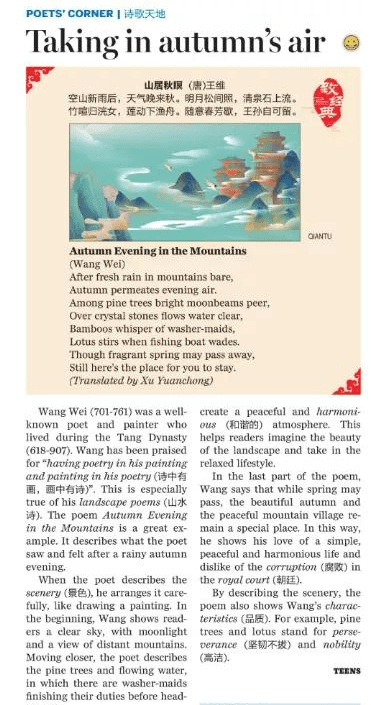



文章轉(zhuǎn)載自 21英語(yǔ)微商城 21世紀(jì)英文報(bào) 秋天來(lái)了,天氣漸涼 讓人不禁想到這句詩(shī) “空山新雨后,天氣晚來(lái)秋。” 山居秋瞑 (唐)王維 空山新雨后,天氣晚來(lái)秋。 明月松間照,清泉石上流。 竹喧歸浣女,蓮動(dòng)下漁舟。 隨意春芳歇,王孫自可留。 Autumn Evening in the Mountains (Wang Wei) After fresh rain in mountains bare, Autumn permeates evening air. Among pine trees bright moonbeams peer, Over crystal stones flows water clear. Bamboos whisper of washer-maids, Lotus stirs when fishing boat wades. Though fragrant spring may pass away, Still here’s the place for you to stay. (Translated by Xu Yuanchong)
Taking in autumn’s air Wang also shows the power of colors in the poem. All the objects he describes are green, white and cyan (青色). These colors can create a peaceful and harmonious (和諧的) atmosphere. This helps readers imagine the beauty of the landscape and take in the relaxed lifestyle. 他還在詩(shī)中展示了色彩的魅力,他所描述的對(duì)象都是綠、白、青色。這些顏色構(gòu)建了寧?kù)o、平和的氛圍,這可以幫助讀者想象那美麗的風(fēng)景,仿佛自己也在那樣輕松的環(huán)境中。 By describing the scenery, the poem also shows Wang’s characteristics (品質(zhì)). For example, pine trees and lotus stand for perseverance (堅(jiān)韌不拔) and nobility (高潔). 通過(guò)描述詩(shī)中場(chǎng)景,這首詩(shī)也顯示了王維為人的品質(zhì)。例如,松樹(shù)和蓮花可以代表堅(jiān)韌不拔和高潔。 
|